Severe Rhabdomyolysis in a 20-year-old Fit Individual: A Case Report and Literature Review
Article Sidebar
Main Article Content
Abstract
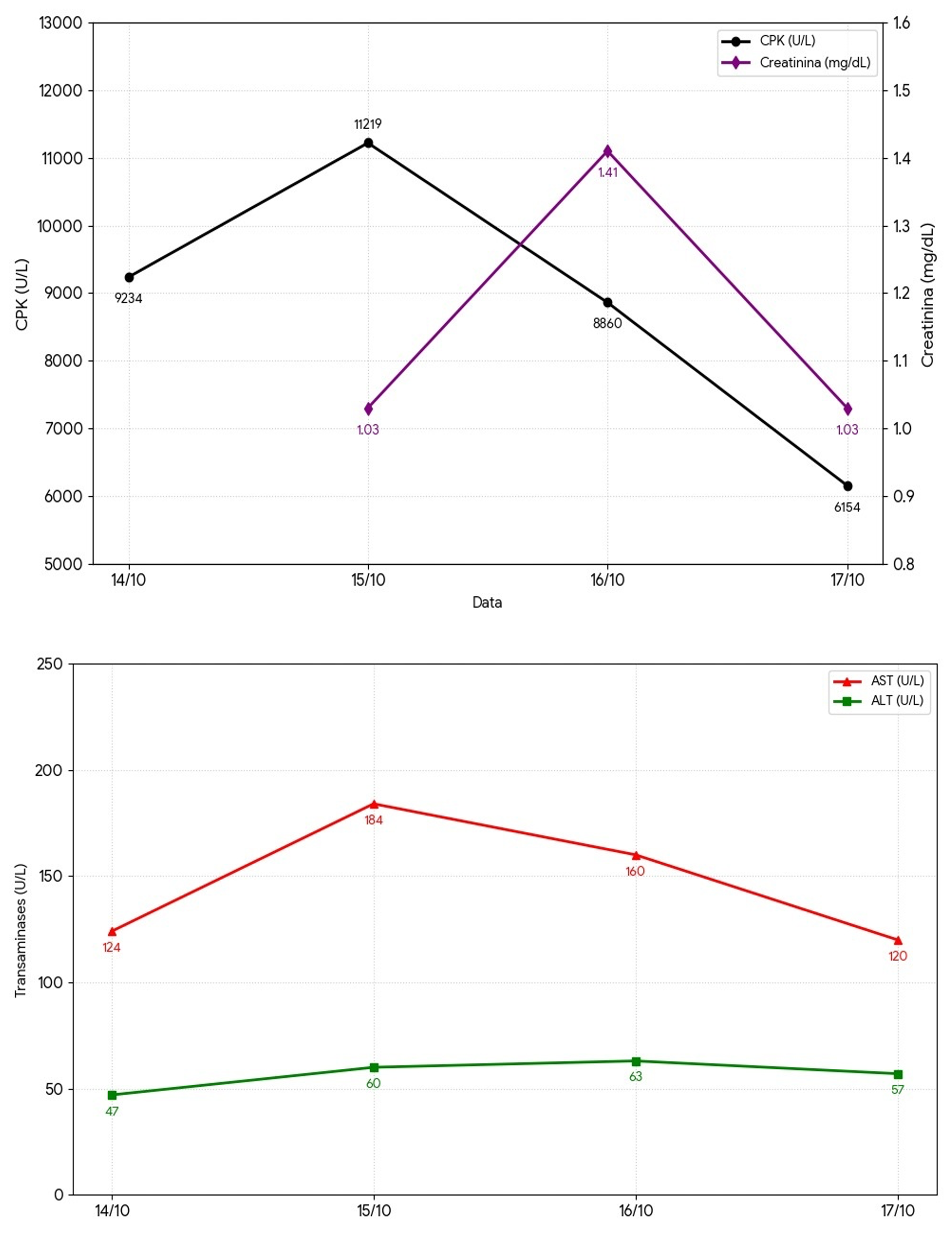
A previously healthy 20-year-old male individual who regularly practiced karate performed moderate physical activity at a gym without adequate hydration. One day after exercising, he developed intense myalgia. After three days, laboratory tests revealed high levels of creatine phosphokinase (CPK), consistent with severe rhabdomyolysis. Other abnormalities were also found, including elevated transaminases and phosphorus. After 5 days, myalgia had been resolved and creatine phosphokinase levels began to decrease, but there was an increase in creatinine and the patient was hospitalized for intravenous hydration. After 1 day of hospitalization, the patient's creatinine normalized and subsequent laboratory tests showed a gradual return of other laboratory markers to normal. We present the pathophysiological mechanisms, diagnosis, and treatment of rhabdomyolysis, highlighting the potential of certain types of exercise to trigger this muscle pathology even in physically active individuals.
Article Details

This work is licensed under a Creative Commons Attribution 4.0 International License.
Authors retain the copyright of their articles and grant the journal the right of first publication under the Creative Commons Attribution (CC BY) license, which allows others to share and adapt the work with proper attribution.
References
Cabral BMI, Edding SN, Portocarrero JP, Lerma EV. Rhabdomyolysis. Disease-a-Month [Internet]. 2020;66(8). doi: 10.1016/j.disamonth.2020.101015.
Yang B-F, Li D, Liu C-L, Luo Y, Shi J, Guo X-Q, Fan H-J, Lv Q. Advances in rhabdomyolysis: A review of pathogenesis, diag-nosis, and treatment. Chinese Journal of Traumatology [Internet]. 2025. doi: 10.1016/j.cjtee.2024.10.005.
Kim J, Lee J, Kim S, Ryu HY, Cha KS, Sung DJ. Exercise-induced rhabdomyolysis mechanisms and prevention: A literature review. Journal Of Sport And Health Science [Internet]. 2015;5(3):324–333. doi: 10.1016/j.jshs.2015.01.012.
Safitri N, Alaina MF, Pitaloka DAE, Abdulah R. A Narrative Review of Statin-Induced Rhabdomyolysis: Molecular Mecha-nism, Risk Factors, and Management. Drug Healthcare And Patient Safety [Internet]. 2021;Volume 13:211–219. doi: 10.2147/dhps.s333738.
Lecina M, Castellar-Otín C, García-Giménez A, Pradas F. Exertional Rhabdomyolysis and Ultra-Trail Races: A Systematic Review Highlighting the Significant Impact of Eccentric Load. Muscles [Internet]. 2024;3(3):242–258. doi: 10.3390/muscles3030022.
Hody S, Croisier J-L, Lacrosse Z, Rogister B. Eccentric Muscle Contractions: Risks and Benefits. Frontiers In Physiology [In-ternet]. 2019;10:536. doi: 10.3389/fphys.2019.00536.
Butts CL. Dehydration, Muscle Damage, and Exercise in the Heat: Impacts on Renal Stress, Thermoregulation, and Muscular Damage Recovery. University Of Arkansas, Fayetteville [Internet]. 2018.
Nance JR, Mammen AL. Diagnostic evaluation of rhabdomyolysis. Muscle & Nerve [Internet]. 2015;51(6):793–810. doi: 10.1002/mus.24606.
Lim AK. Abnormal liver function tests associated with severe rhabdomyolysis. World Journal Of Gastroenterology [Inter-net]. 2020;26(10):1020–1028. doi: 10.3748/wjg.v26.i10.1020.
Raju N, Rao S, Joel J, Jacob G, Anil A, Gowri S, Kandasamy S. Predictive value of serum myoglobin and creatine phosphoki-nase for development of acute kidney injury in traumatic rhabdomyolysis. Indian Journal Of Critical Care Medicine [Inter-net]. 2017;21(12):852–856. doi: 10.4103/ijccm.ijccm_186_17.
Margaritopoulos S, Theodorou A, Methenitis, Zaras N, Donti O, Tsolakis C. The Effect of Plyometric Exercises on Repeated Strength and Power Performance in Elite Karate Athletes. Journal Of Physical Education And Sport [Internet]. 2015;15(2). doi: 10.7752/jpes.2015.02047.
Dermott EJM, Balshaw TG, Brooke-Wavell K, Maden-Wilkinson TM, Folland JP. Fast and ballistic contractions involve greater neuromuscular power production in older adults during resistance exercise. European Journal Of Applied Physiolo-gy [Internet]. 2022;122(7):1639–1655. doi: 10.1007/s00421-022-04947-x.