Recurrent Multicystic Peritoneal Mesothelioma in a Young Male Patient: A Case Report
Article Sidebar
Main Article Content
Abstract
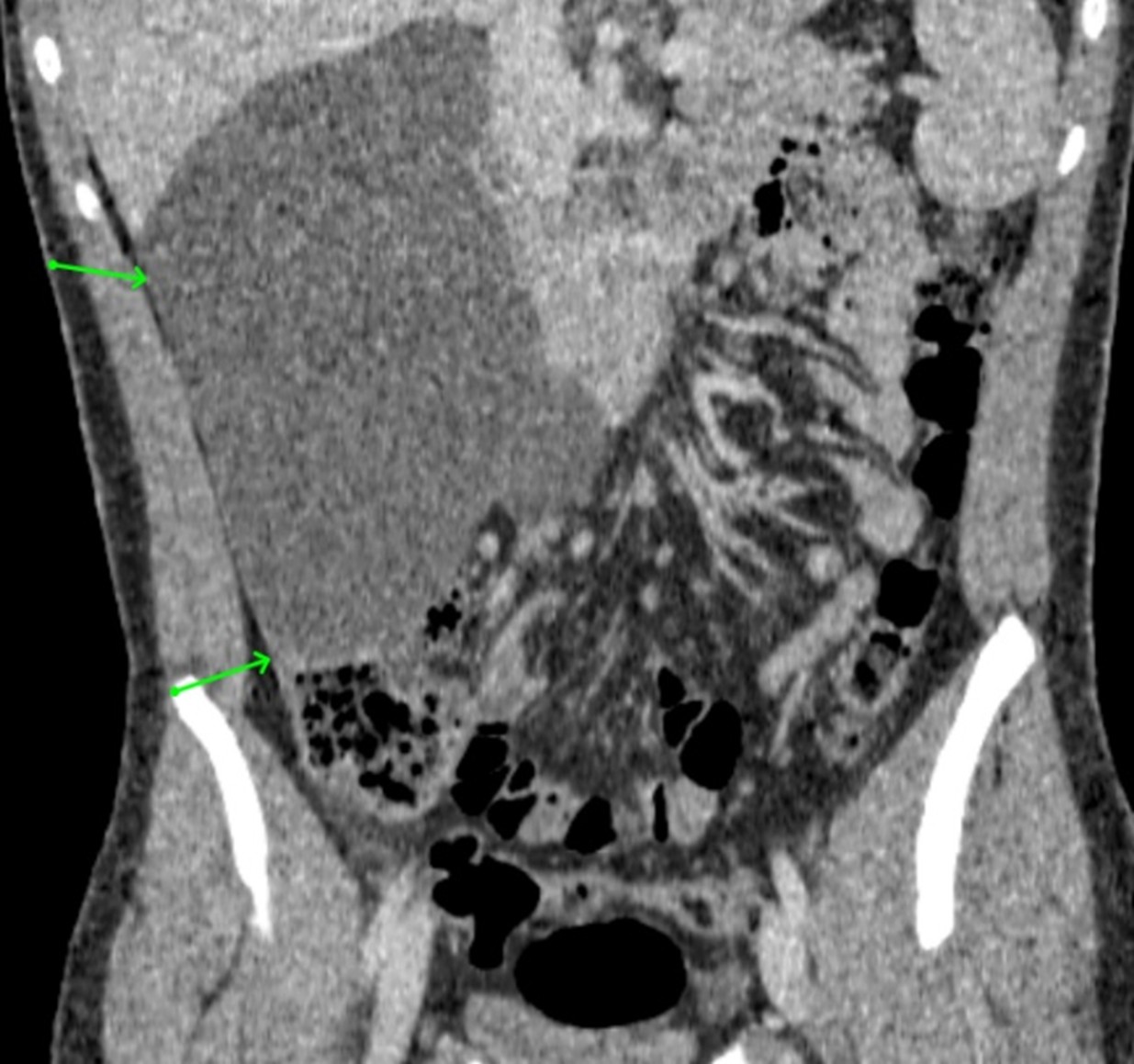
Multicystic peritoneal mesothelioma (MPM) is a rare benign neoplasm of mesothelial origin, whose pathogenesis is often associated with chronic inflammatory processes, differing etiologically from malignant mesothelioma due to its lack of association with asbestos exposure. We report the case of a young male patient presenting with chronic, nonspecific abdominal symptoms. Imaging evaluation (CT and MRI) revealed multiple septated cystic lesions consistent with the hypothesis of MPM, demonstrating a molding pattern along adjacent peritoneal surfaces (molding sign), without evidence of parenchymal invasion. Despite surgical resection with no macroscopic residual disease (complete excision), the patient developed local recurrence within 24 months. This report emphasizes that, although histologically benign, MPM exhibits a high rate of biological recurrence, requiring a rigorous long-term radiological surveillance protocol and a multidisciplinary therapeutic approach.
Article Details

This work is licensed under a Creative Commons Attribution 4.0 International License.
Authors retain the copyright of their articles and grant the journal the right of first publication under the Creative Commons Attribution (CC BY) license, which allows others to share and adapt the work with proper attribution.
References
Noiret B, Renaud F, Piessen G, Eveno C. Multicystic peritoneal mesothelioma: a systematic review of the literature. Pleura Peritoneum. 2019 Sep 01;4(3):20190024. doi: 10.1515/pp-2019-0024.
Nizri E, Bar-David T, Nissan A, Peretz T, Ben-David M. Multicystic Peritoneal Mesothelioma: Operative and Long-Term Outcomes with Cytoreductive Surgery and Hyperthermic Intra Peritoneal Chemotherapy. Ann Surg Oncol. 2018 Nov;25(11):3724-3730. doi: 10.1245/s10434-018-6712-6.
Choudhary S, Fasih N, Mc Innes M, Marginean C. Benign multicystic peritoneal mesothelioma in a male patient. J Radiol Case Rep. 2013 Nov 01;7(11):1-7. doi: 10.3941/jrcr.v7i11.1666.
Husain AN, Colby TV, Ordóñez NG, Krausz T, Borczuk A, Cagle PT, Churg A, Cortez FP, Finkelstein S, Fraire AE, Gala-teau-Salle F, Gibbs AR, Gown AM, Hammar SP, Liz-Guerrero R, Roggli VL, Travis WD, Wick MR. Guidelines for Pathologic Diagnosis of Mesothelioma 2017 Update of the Consensus Statement from the International Mesothelioma Interest Group. Arch Pathol Lab Med. 2018 Jan;142(1):89-108. doi: 10.5858/arpa.2017-0124-RA.
Baratti D, Kusamura S, Sironi A, Cabras A, Fumagalli L, Laterza B, Deraco M. Multicystic peritoneal mesothelioma: outcomes and patho-biological features in a multi-institutional series treated by cytoreductive surgery and Hyperthermic Intraperi-toneal Chemotherapy (HIPEC). Ann Surg Oncol. 2010 Oct;17(10):2798-2808. doi: 10.1245/s10434-010-1110-x.
Pickhardt PJ, Bhalla S. Primary neoplasms of peritoneal and subperitoneal origin: CT findings. Radiographics. 2005 Jul-Aug;25(4):983-995. doi: 10.1148/rg.254045142.
Hida T, Hamakawa T, Hayashi T, Igarashi T, Ishida H, Shibuya H, Saitoh S, Kato T, Sakai K, Asano T, Simadzu M, Matsuoka K, Mitsui K, Iwamura M, Hiroshima K. BAP1 immunohistochemistry and p16 FISH to separate benign from malignant me-sothelial proliferations. Am J Surg Pathol. 2015 Feb;39(2):201-210. doi: 10.1097/PAS.0000000000000324.
Boussios S, Moschetta M, Karathanasi A, Tsiouris AK, Kanellos FS, Tatsi K. Malignant peritoneal mesothelioma: clinical aspects, and therapeutic perspectives. Ann Gastroenterol. 2018 Nov-Dec;31(6):659-669. doi: 10.20524/aog.2018.0305.