Penetrating Cervical Trauma Following a Suicide Attempt in a Young Patient: A Case Report
Article Sidebar
Main Article Content
Abstract
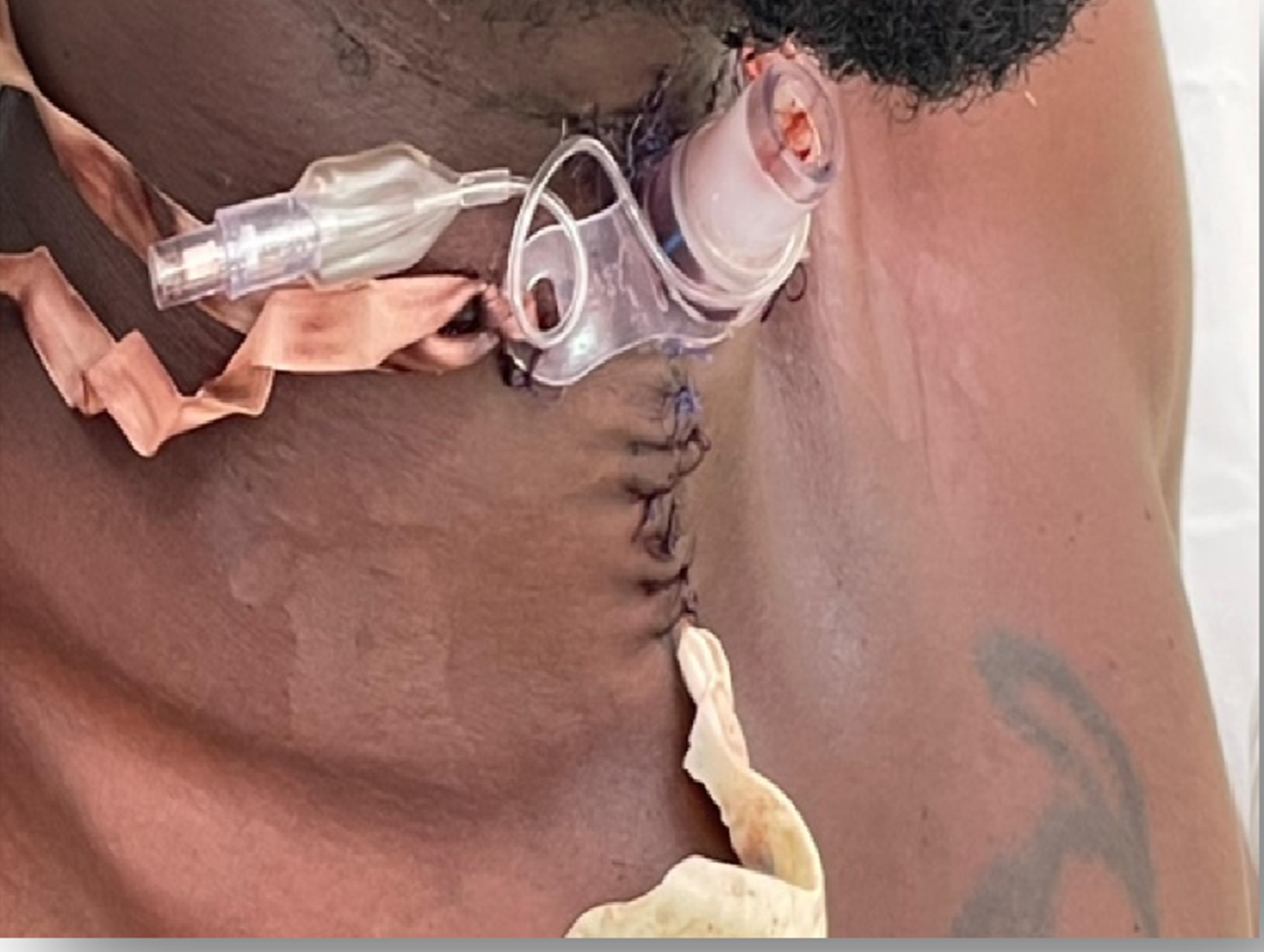
A 23-year-old previously healthy male patient was admitted following a suicide attempt by strangulation using a metallic wire associated with blunt trauma to the anterior cervical region. Initial examination revealed an extensive laceration-contusion injury in zone II of the neck, with significant active bleeding and exposure of laryngotracheal structures. Surgical exploration identified a grade III laryngeal injury according to the Schaefer-Fuhrman classification, with complete mucosal exposure, as well as a grade IV tracheal injury based on the American Association for the Surgery of Trauma (AAST) classification, involving loss of more than five tracheal rings. No injuries to major cervical vessels or nerves were observed. Tracheostomy, laryngorrhaphy, and hemostasis by ligation of small vessels of the prethyroid musculature associated with electrocautery were performed. The patient remained hospitalized in the intensive care unit for five days, followed by 15 days of inpatient care, receiving multidisciplinary follow-up from general surgery, psychology, and psychiatry teams. During clinical evolution, persistent suicidal behavior was observed, requiring sedation and intensive surveillance. The patient was discharged with outpatient follow-up and antidepressant therapy. This case illustrates the severity of penetrating cervical trauma associated with suicide attempts, highlighting the importance of immediate surgical management and integrated psychiatric care, while also discussing the global and national epidemiology of suicide.
Article Details

This work is licensed under a Creative Commons Attribution 4.0 International License.
Authors retain the copyright of their articles and grant the journal the right of first publication under the Creative Commons Attribution (CC BY) license, which allows others to share and adapt the work with proper attribution.
References
The Lancet Public Health. Global burden of suicide mortality: analysis 1990– 2021. Lancet Public Health. 2025;10(2):e123-e135.
World Health Organization. Suicide worldwide in 2023: global health estimates. Geneva: WHO; 2023.
Mars B, Burrows S, Hjelmeland H, Gunnell D. Suicide in sub-Saharan Africa: an emerging public health crisis. Int J Environ Res Public Health. 2024;21(7):445–456.
Osafo J, Akotia CS, Andoh-Arthur J. Suicide in Ghana and sub-Saharan Africa: medico-legal perspectives. Afr J Psychiatry. 2022;25(4):233–240.
Freitas JTD, Lino RZDS, Moura MFR. Enforcamento atípico – relato de caso de morte por constrição cervical. Perspectivas em Medicina Legal e Perícia Médica. 2025.
Correio da Kianda. Angola com mais de três mil mortes por suicídio em quatro anos. 2024.
Deutsche Welle. Angola: Suicídio já é um caso de saúde pública? 2025.
Diário Independente. Enforcamento entre os casos de suicídios com números alarmantes em Angola. 2024.
Noleto I, Fortes MI. O trauma e a urgência psíquica na clínica do suicídio. Analytica. 2022;11(20):1-15.
Leão MH, Duarte LF. Revisão teórica integrativa acerca dos possíveis fatores que levam à tentativa de suicídio. Rev Cient Multidisciplinar Núcleo do Conhecimento. 2020;11(11):45-62.
Ministério da Saúde (Brasil). Boletim Epidemiológico nº 55 – Panorama dos suicídios e lesões autoprovocadas no Brasil 2010–2021. Brasília: SVSA; 2024.
Caliman MO, Silva MA, Andrade LS, Guzman IRE, Santos MVF, Siqueira M. Vigilância epidemiológica das tentativas de suicídio: avaliando a qualidade dos dados. Rev Port Enferm Saúde Mental. 2022;28:31-42.