Disseminated Paracoccidioidomycosis: Cutaneous and Osteoarticular Involvement in an Immunocompetent Patient
Article Sidebar
Main Article Content
Abstract
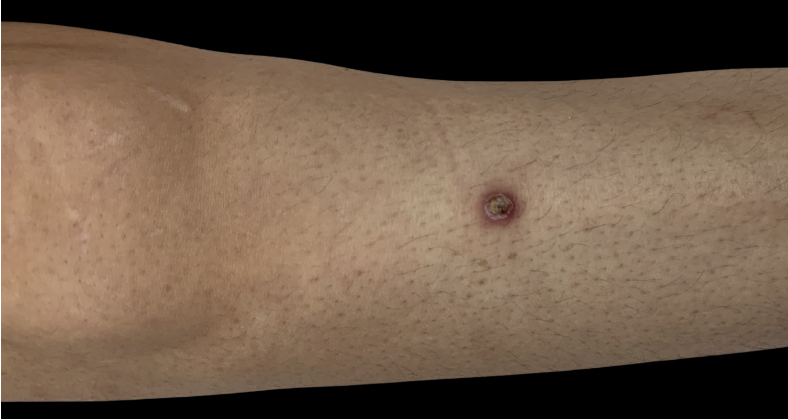
Paracoccidioidomycosis (PCM) is a systemic mycosis caused by Paracoccidioides spp. Cutaneous and osteoarticular involvement is uncommon, especially in immunocompetents, and can present a diagnostic challenge. We report a case of disseminated PCM in a previously healthy 36-year-old woman from southeastern Brazil, without recognised rural exposure, who presented with right ankle monoarthritis, followed by systemic symptoms and cutaneous lesions. Imaging revealed diffuse pulmonary micronodules, bone lesions and a pathological tibial fracture. Direct mycological examination of bronchoalveolar lavage fluid and fungal culture of a skin biopsy were positive. Skin and bone biopsies demonstrated multiple-budding fungal structures compatible with Paracoccidioides spp. Disseminated PCM was diagnosed, with satisfactory response to liposomal amphotericin B followed by itraconazole and with substantial functional recovery. PCM should be considered in unexplained osteoarticular lesions, even without recognised epidemiological risk factors.
Article Details

This work is licensed under a Creative Commons Attribution 4.0 International License.
Authors retain the copyright of their articles and grant the journal the right of first publication under the Creative Commons Attribution (CC BY) license, which allows others to share and adapt the work with proper attribution.
References
Shikanai-Yasuda MA, Mendes RP, Colombo AL, Queiroz-Telles F, Kono ASG, Paniago AMM, et al. Brazilian guidelines for the clinical management of paracoccidioidomycosis. Rev Soc Bras Med Trop. 2017;50(5):715-740. doi:10.1590/0037-8682-0230-2017.
Canteros CE. Paracoccidioidomicosis: crónica de una enfermedad olvidada [Paracoccidioidomycosis: chronicle of a neglec-ted disease]. Medicina (B Aires). 2018;78(3):180-184.
Kruschewsky WLL, Stricagnolo MC, Vidal MSMM, Benard G, Oliveira VF, Cocio TA, et al. Clinical patterns of osteoarticu-lar, bone marrow and urogenital paracoccidioidomycosis. Mycoses. 2026;69(5):e70182. doi:10.1111/myc.70182.
Curtis KL, Gold JAW, Ritter JM, Rosen T, Santos DWCL, Smith DJ, et al. Dermatologic fungal neglected tropical disea-ses—Part I. Epidemiology and clinical features. J Am Acad Dermatol. 2025;92(6):1189-1206. doi:10.1016/j.jaad.2024.03.056.
Brito TGN, Taborda M, Provenci B, Costa AN, Benard G. A case-control study of paracoccidioidomycosis in women: the hormonal protection revisited. J Fungi (Basel). 2021;7(8):655. doi:10.3390/jof7080655.
García-Martín JM, Muro A, Fernández-Soto P. Diagnosis of human endemic mycoses caused by thermally dimorphic fungi: from classical to molecular methods. J Fungi (Basel). 2024;10(9):637. doi:10.3390/jof10090637.
Kruschewsky WLL, de Freitas VLT, Taborda M, Quadros IAAO, Vidal MSMM, Cocio TA, et al. Therapeutic drug monito-ring of itraconazole in endemic paracoccidioidomycosis: real-world data. Mycopathologia. 2026;191(1):5. doi:10.1007/s11046-025-01032-7.