Óleo de Canabidiol de Espectro Completo como Estratégia de Manejo Sintomático na Língua Geográfica: Relato de Caso com Revisão da Literatura
Barra lateral de artigos
Conteúdo do artigo principal
Resumo
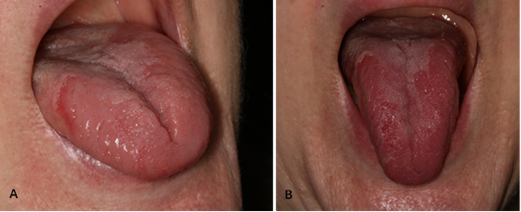
Relatar um caso de língua geográfica (LG) sintomática tratado com sucesso com óleo de canabidiol (CBD) de espectro completo, destacando a dinâmica dose–resposta, a titulação individualizada e os desfechos clínicos. Paciente do sexo feminino, 60 anos, apresentou história de cinco meses de sintoma de ardência oral. O exame clínico revelou múltiplas áreas atróficas com bordas esbranquiçadas no dorso da língua. Os exames laboratoriais estavam dentro da normalidade, exceto por níveis levemente reduzidos de vitamina D. O uso prévio de corticosteroides tópicos proporcionou alívio sintomático transitório. O óleo de CBD (3000 mg/30 mL) foi administrado por via sublingual, iniciando-se com 5 mg duas vezes ao dia e titulado semanalmente de acordo com a intensidade da dor mensurada pela Escala Visual Analógica (EVA). A paciente apresentou melhora significativa (EVA reduzida de 8 para 2) com 4 gotas duas vezes ao dia. Não foram relatados efeitos adversos durante três meses de acompanhamento. Embora a LG geralmente não requeira tratamento, casos sintomáticos podem impactar significativamente a qualidade de vida. As propriedades analgésicas, anti-inflamatórias e moduladoras do estado emocional do canabidiol (CBD) podem explicar a melhora clínica observada. A resposta clínica não linear reforça a importância da titulação individualizada da dose e do monitoramento cuidadoso. O óleo de CBD de espectro completo pode representar uma abordagem terapêutica potencial para pacientes com LG persistente. A titulação cuidadosa é essencial para otimizar os resultados. Estudos controlados adicionais são necessários para confirmar a eficácia e estabelecer protocolos de dosagem baseados em evidências.
Detalhes do artigo

Este trabalho está licenciado sob uma licença Creative Commons Attribution 4.0 International License.
Authors retain the copyright of their articles and grant the journal the right of first publication under the Creative Commons Attribution (CC BY) license, which allows others to share and adapt the work with proper attribution.
Referências
Sarruf MBJM, Quinelato V, Sarruf GJM, Oliveira HE, Calasans-Maia JA, Quinelato H, et al. Stress as worsening of the signs and symptoms of the geographic tongue during the COVID-19 pandemic: a pilot study. BMC Oral Health. 2022 Dec 3;22(1):565.
Dafar A, Bankvall M, Garsjö V, Jontell M, Çevik‐Aras H. Salivary levels of interleukin‐8 and growth factors are modulated in patients with geographic tongue. Oral Dis. 2017 Sept;23(6):757–62.
Su N, Poon R, Liu C, Dewan C, Darling M, Grushka M. Taste and Pain Response in Burning Mouth Syndrome With and Without Geographic Tongue. J Oral Facial Pain Headache. 2020 July;34(3):217–21.
Picciani BLS, Santos LR, Teixeira-Souza T, Dick TNA, Carneiro S, Pinto JMN, et al. Geographic tongue severity index: A new and clinical scoring system. Oral Surg Oral Med Oral Pathol Oral Radiol. 2020 Apr;129(4):330–8.
Dick TNA, Santos LR, Cunha KS, Silva-Junior GO, Dziedzic A, Aredes MM, et al. Correlation between extent and clinical severity, and histopathological characteristics of geographic tongue. Folia Morphol. 2025 July 9;84(2):398–405.
De Campos WG, Esteves CV, Fernandes LG, Domaneschi C, Júnior CAL. Treatment of symptomatic benign migratory glo-ssitis: a systematic review. Clin Oral Investig. 2018 Sept;22(7):2487–93.
Ślebioda Z, Drożdżyńska J, Karpińska A, Krzyżaniak A, Kasperczak M, Tomoń N, et al. Clinical Characteristics and Risk Factors of Geographic Tongue: A Retrospective Analysis of 100 Polish Patients.
Stahl V, Vasudevan K. Comparison of Efficacy of Cannabinoids versus Commercial Oral Care Products in Reducing Bacterial Content from Dental Plaque: A Preliminary Observation. Cureus [Internet]. 2020 Jan 29 [cited 2025 Sept 24]; Available from: https://www.cureus.com/articles/25300-comparison-of-efficacy-of-cannabinoids-versus-commercial-oral-care-products-in-reducing-bacterial-content-from-dental-plaque-a-preliminary-observation
MacCallum CA, Russo EB. Practical considerations in medical cannabis administration and dosing. Eur J Intern Med. 2018 Mar;49:12–9.
Bernaola-Paredes WE, Filho VB, Vilela Dias EM, Sugaya NN. A case of migratory stomatitis in a young male patient: Ma-nagement and differential diagnosis. J Oral Maxillofac Pathol. 2022 Feb;26(Suppl 1):S17–21.
Núñez Amin Dick T, Rocha Santos L, Carneiro S, Moore D, Pestana S, Laerte Boechat J, et al. Investigation of oral atopic diseases: Correlation between geographic tongue and fungiform papillary glossitis. J Stomatol Oral Maxillofac Surg. 2021 June;122(3):283–8.
Garsjö V, Dafar A, Jontell M, Çevik‐Aras H, Bratel J. Increased levels of calprotectin in the saliva of patients with geographic tongue. Oral Dis. 2020 Apr;26(3):558–65.
Panda B and Ghosh D. Pathophysiology & Treatment of Geographic Tongue: A Mini Review. Acta Neurophysiol 2023, 4(6): 180037.
Stoopler ET, France K, Ojeda D, Sollecito TP. Benign Migratory Glossitis. J Emerg Med. 2018 Jan;54(1):e9–10.
Horiuchi Y. Geographic tongue: What is this disease? JDDG J Dtsch Dermatol Ges. 2023 Dec;21(12):1465–7.
S Kurtipek G, Sarı N, T Akyürek F. Geographic tongue that responds to the treatment of pregabalin: Can it be a new treatment choice? Dermatol Ther. 2019 Jan;32(1):e12776. doi: 10.1111/dth.12776. Epub 2018 Nov 18. PMID: 30365234.
Amasyalı SY, Gürses AA, Aydın ON, Akyol A. Effectiveness of Pregabalin for Treatment of Burning Mouth Syndrome. Clin Psychopharmacol Neurosci. 2019 Feb 28;17(1):139–42.
Hossain MK, Chae HJ. Medical cannabis: From research breakthroughs to shifting public perceptions and ensuring safe use. Integr Med Res. 2024 Dec;13(4):101094.
Zuardi AW, Rodrigues NP, Silva AL, Bernardo SA, Hallak JEC, Guimarães FS, et al. Inverted U-Shaped Dose-Response Curve of the Anxiolytic Effect of Cannabidiol during Public Speaking in Real Life. Front Pharmacol. 2017 May 11;8:259.
Lafaye G, Karila L, Blecha L, Benyamina A. Cannabis, cannabinoids, and health. Dialogues Clin Neurosci. 2017 Sept 30;19(3):309–16.
Campana MD, De Paolis G, Sammartino G, Bucci P, Aliberti A, Gasparro R. Cannabinoids: Therapeutic Perspectives for Management of Orofacial Pain, Oral Inflammation and Bone Healing—A Systematic Review. Int J Mol Sci. 2025 Apr 16;26(8):3766.
Bloomfield MAP, Yamamori Y, Hindocha C, Jones APM, Yim JLL, Walker HR, et al. The acute effects of cannabidiol on emotional processing and anxiety: a neurocognitive imaging study. Psychopharmacology (Berl). 2022 May;239(5):1539–49.
Han K, Wang JY, Wang PY, Peng YCH. Therapeutic potential of cannabidiol (CBD) in anxiety disorders: A systematic review and meta-analysis. Psychiatry Res. 2024 Sept;339:116049.
Henson J, Vitetta L, Quezada M, Hall S. Enhancing Endocannabinoid Control of Stress with Cannabidiol. J Clin Med. 2021 Dec 14;10(24):5852.
Neves LBM, Lima BC, Marques FV, Baldessarini BL, Machado RCM. Cannabinology in Dentistry: Therapeutic Applications and Future Directions. Int J Oral Dent Health. 2025 Aug 19;12(2):1–4.
Mederos M, Salvi LC, Chisini LA. The therapeutic effect of cannabidiol in oral mucosa lesions: a scoping review of in vivo and clinical studies. Braz J Oral Sci. 2025 Mar 28;24:e255518.
Linares IM, Zuardi AW, Pereira LC, Queiroz RH, Mechoulam R, Guimarães FS, et al. Cannabidiol presents an inverted U-shaped dose-response curve in a simulated public speaking test. Braz J Psychiatry. 2019 Feb;41(1):9–14.
Batista MM. Primeiras orientações ao prescritor de cannabis medicinal: uma revisão narrativa baseada na literatura científica e na atual regulamentação brasileira. Ufopbr [Internet]. 2024 [cited 2025 Sep 24]; Available from: https://www.monografias.ufop.br/handle/35400000/8072
Xavier Viana TR, De Paula Venute L, Teixeira Coelho A, Ribeiro De Souza D, Xavier De Deus R, Crivoi Cesar A, et al. Cannabis Medicinal: Uma Revisão sobre as Perspectivas Atuais e Desafios Futuros na Prática Clínica. J Res Med Health. 2024 Apr 15;2:e202401.